Web Access Things!

Web Access Things!

ALT Text: All images on this page are embedded  with ALT text. Text Size: If you are using Internet Explorer, Chrome or Firefox and ha...

Tuesday, 25 April 2017

Vulva Is Asymptomatic

Image description: one crochet genital of blue hues is pictured on a white background. It looks rather unassuming, to represent asymptomatic STIs.

In the context of STIs, asymptomatic means that a person can have an STI present in the body but does not show any visible symptoms, and does not experience any. STIs that can be asymptomatic include: Gonorrhea, Chlamydia, Trichomonasis, Human Papillomavirus, Herpes Simplex 1 (oral) and Herpes Simplex 1 (anal/genital), Hepatitis B+C and Human Immunodeficiency Virus (HIV).

When STIs do show symptoms they can be: urethral like burning during urination; cervical like vaginal discharge; anogenital lesions like herpes blisters; pelvic inflammatory disease that includes lower abdominal pain; vaginal erythema (pain, soreness, burning rawness of the vaginal canal and opening); nausea; diarrhea; and fever to name a few.

While it is important to be able to recognize STI symptoms it is also important to remember that not all STIs will show symptoms and that asymptomatic STIs can still be passed from one person to another. Furthermore, even when they do show symptoms sometimes they can be mistaken as something else, like a cold or fever. So getting tested as best suits our sexual and drug use history is one way of knowing our STI status.

If you live in Ontario, even if you are not a citizen or permanent resident, there are clinics and community health centers where you can get access to testing and treatment ina number of languages. To find a clinic near you check: http://sexualhealthontario.ca/find-a-clinic/ or call toll free: 1 (800) 688-2437

Monday, 10 April 2017

Vulva is HPV Positive

Image description: one crochet genital of yellow hues is pictured on a white background. Dark brown glass beads located at various spots represent anogenital warts. #vulvais #tulymaimouna #crochet #endstigma

I got my first genital wart last year. I felt a mild burning/itching sensation in my butt and when I looked with a mirror I noticed a small flesh coloured bump that was new to me. Since I regularly check my genitals for any signs of changes, and had seen what warts looked like on another persons genitals it was easy for me to identify.

Human Papilomavirus (HPV) is a very common STI, 70% of the sexually active population in Kanata (Canada) will have at least one HPV infection over their lifetime. There are over 200 types of HPV with different health outcomes.  "Low risk" (rarely cancer causing) type of HPV can lead to anal and/or genitals warts, while "high risk" (carcinogenic - cancer causing) HPV can cause pre-cancerous lesions and cervical or anal cancer. 

Symptoms:
Sometimes there are none at all, however anogenital (anal/genital) warts usually they are: bumpy (like cauliflower) or flat, their colour depends on a persons skin tone

Transmission: 
Genital skin-to-skin contact with someone who has HPV in their body, e.g barrier free anal, vagina/front and oral sex

Treatment:
Most cases of HPV can be cleared by the body on its own, so treatment depends on what type of HPV is present and the extent of the infection. With anogenital warts sometimes freezing the warts off with liquid nitrogen or laser therapy are options. With mild anogenital cell changes determined by an abnormal anal or cervical pap smear, a "wait and watch" approach along with follow ups to examine the cervix, vagina, external genitalia, or anus for symptoms can be taken. If pre-cancerous or cancerous lesions are present a biopsy could be necessary.

Some prevention options:
Gardasil-9 vaccine protects against 9 types of HPV, internal condoms cover a larger surface area than external condoms, have warts removed, not shaving or having sex while warts are present to avoid spreading them around the genitals. Note: to date there is no routine STI test for anogenital warts.

Please note: The vaccine is administered in two or three doses, and completing the vaccine series takes roughly 9 months. So for the vaccines to be entirely funded the series needs to be completed before you turn 27.

If you live in Ontario "the publicly funded human papiloma virus (HPV) vaccine includes men who have sex with men (MSM) who are 9- 26 years of age or younger and identify as gay, bisexual as well as other MSM - including some trans people."  *I called the AIDS and Sexual Health Info Line to clarify what "some trans people" means and was told there is no qualifying marker for which trans people can access the vaccine.

For more information check out: http://sexualhealthontario.ca/hpv-vaccine-for-eligible-men/
AIDS and Sexual Health Info Line:
Toll free: 1-800-668-2437, Local: 416-392-2437 (available in over 16 languages)
Hours: Monday - Friday 10AM-10:30PM, Saturday & Sunday 11AM- 3PM
Or try their eChat service from Monday – Friday: 10 a.m. – 5 p.m. (in English only)


Thursday, 16 March 2017

Vulva is Chlamydia Positive

Image description: one crochet genital of pink hues is pictured on a white background. Inside the canal is reddened slightly to represent the irritating itchiness of chlamydia

I was 17 when I got chlamydia for the first time. At the time, I was dating someone who one day before going down on me asked me "I don't mean to sound rude, but why does your crotch smell like this?" After pointing this out I simply thought that change in my discharge and odor, plus the slight itchiness and redness were symptoms of a coming yeast infection. Much later the person I was seeing got tested during a physical and let me know they had chlamydia. We had had sex without condoms a few times and never talked about getting tested together.

Chlamydia is a super common bacterial STI that can transmitted through oral and penetrative sex (butt and front (vagina) sex) without a barrier, and child birth. 

Symptoms: lots of STI's share similar symptoms that make it difficult to figure out what is happening. It is also quite common to show no symptoms at all, so getting tested is the best way to know. Some symptoms are: burning while peeing, spotting between cycles, pain in lower abdomen, pain during or after penetrative sex, a change or increase in discharge. 

Treatment: oral antibiotics. if left untreated it can lead to infertility in all humans, pelvic inflammatory disease, chronic pelvic pain, pregnancy outside the uterus (ectopic pregnancy)

Prevention: there are lots of options! getting tested (yourself and your sexual partner/s), completing antibiotic treatment, having sex with barriers, abstinence (if that's your flex), having sex again once the chlamydia is cleared (to prevent passing it between each other). 

Wednesday, 1 March 2017

Buzzing Flies: An Incest Purge

pictured in front of a white background, the torso of a mannequin with no arms is painted with dark brown acrylic paint and has a black paper mache afro. locates on the stomach of the mannequin is a large hairy terracotta vulva with white discharge that is surrounded by flies.
Buzzing Flies: An Incest Purge
2016
Medium: Acrylic,terracotta and papier-mache on fibreglass

Content warning: Incest, sexual violence, healing!

Last year was my chrysalis year. Moving into 2016 I felt like a caterpillar, and I kept asking myself if a caterpillar knew, upon creating its chrysalis, what it would emerge as. I had mentioned before that my mental health was a mess. I was shaken to a point where my body, spirit and mind no longer had the capacity to hold onto all of the things I had suppressed within my being, particularly around incest and sexual violence. Moving through/with my cocooning process (marked by lots of crying, confusion, anguish, fear and anger) I made the decision to transmute the energy of shame I was carrying about my experiences into art. It was (and still is) my purging process.

This multi-medium sculpture is a slow descent into madness and a projection of incest. It holds decades of incessant buzzing flies; an internal rotting ensues delusion, repression, anxiety and depression from internalizing shame, disgust, anger, guilt, blame and fear. It is the reality of longing to let go, but the fucked up experience of finding comfort in the familiarity of trauma. Nursing its existence silently out of routine.

It is simultaneously a call to exhale. To sculpt and recreate the possibilities of my existence beyond the limitations of traumatic experiences. Enacting personal power by taking responsibility of my process of becoming, and cultivating a path of love from lessons of pain.

I made this piece for Nuit Rose: A Festival of Queer Art and Performance for Toronto Pride 2016.

two people varying in race and gender are bent down looking at the scuplture
Photo by: Tanya Turton

Sunday, 26 February 2017

Vulva Is Resistant to Antibiotics

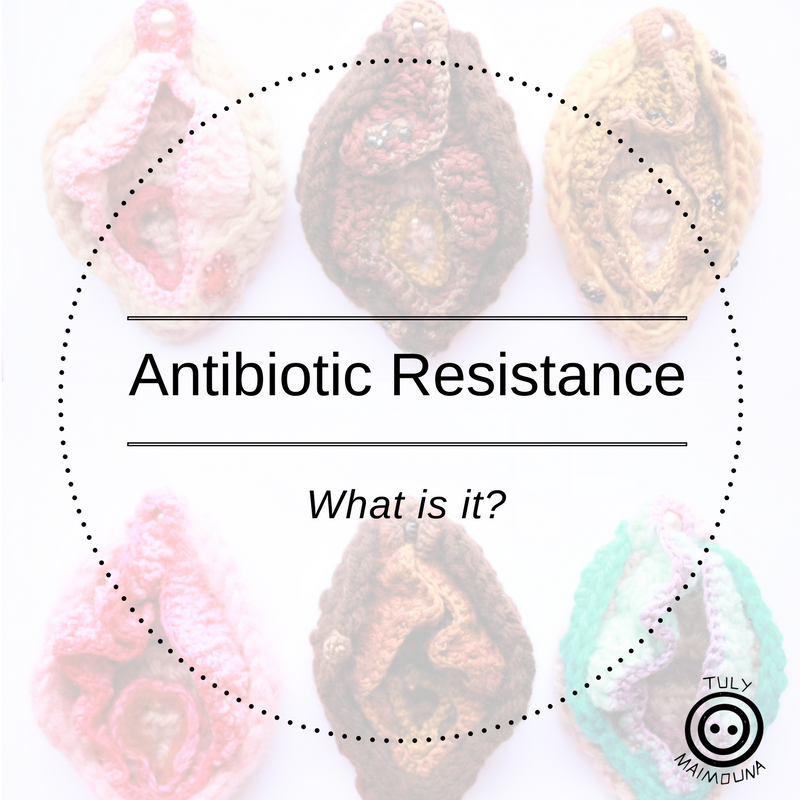
within a dotted circle black text reads, antibiotic resistance, what is it? The background image is a faded image of 6 crochet genitalia of different colours with varying representations of STI symptoms. vulva is

Antibiotic resistance is when bacteria are no longer responsive to antibiotics that are meant to kill them. When a bacteria is exposed to treatment too often (over-reliance on antibiotic treatment as illness management) or at infrequent low doses (when treatment is not fully completed/adhered to), like other living organisms its DNA changes to be able to survive.

Why does it matter?
Globally, there have been reports of gonorrhea (N. gonorrhoeae - bacteria name) strains that are resistant to first-line antibiotic therapy (like penicillin, tetracycline, erythromycin and ciprofloxacin - types of antibiotics). When bacterial infections, like gonorrhea, are no longer responsive to the medical treatments available it remains untreated in the body and can lead to health complications like: infertility, chronic pelvic pain, bacteria spreading to the blood causing nervous system damage, parent to child transmission, or ectopic pregnancies. Also, the presence on an STI in the body increases the likelihood getting another STI like chlamydia, or HIV (the virus that can lead to AIDS).

In Kanata (Canada), gonorrhea is the second most commonly diagnosed and reported bacterial STI. Much like the incidences of STIs, antibiotic resistance will vary from country to country, even regionally. The distribution of antibiotic resistance can be thought of in the same way as other STIs, the social determinants of health and health inequities are really important when thinking about why there are higher rates of certain antibiotic resistance both geographically and socially.

Sources Cited:
1. Centre of Disease Control and Prevention. 2017. Drug-Resistant Gonorrhea. Retrieved from: https://www.cdc.gov/drugresistance/solutions-initiative/drug-resistant-gonorrhea.html 

2. Public Health Agency of Canada. 2013. Canadian Guidelines on Sexually Transmitted Infections. Retrieved from: http://www.phac-aspc.gc.ca/std-mts/sti-its/cgsti-ldcits/section-5-6-eng.php#toc361210445
3. Public Health Agency of Canada. 2015. Canada Communicable Disease Report. Retrieved from: http://www.phac-aspc.gc.ca/std-mts/sti-its/cgsti-ldcits/section-5-6-eng.php#toc361210445
4. Tapsall J. Antibiotic resistance in Neisseria gonorrhoeae is diminishing available treatment options for gonorrhoea: Some possible remedies. Expert Rev Anti Infect Ther. 2006; 4:619-628

Tuesday, 21 February 2017

Vulva Is Syphilis Postive

one crochet genital with brown inner and outer lips and a brown clitoris is pictured on a white background. On the left outer lip is a light brown chancre that looks like a small bump, and it represents primary stage syphilis. Vulva Is.

Syphilis is a bacterial sexually transmitted infection (STI) that when present in the body can be passed on through skin-to-skin contact, birth, sharing used works (like crack pipes) for inhaling drugs, and sex without a barrier (condoms, gloves or dental dams). 


Symptoms:
Syphilis can progress through 3 stages if left untreated. In primary syphillis a small painless lesion (chancre) appears- then goes away, even if left untreated. In secondary syphilis- a rash develops on the body with flu like symptoms, and tertiary syphilis can lead to long term complications like brain damage or stroke.

Treatment:
Syphilis can be treated with antibiotics. It kills the bacteria in the body, but it does not reverse any damage it may have done.

Some options on prevention:
getting tested, completing treatment, using barriers when having sex, using new works and having convos with sexual partners about STIs

Historical (racist) fact:
Syphilis has come to symbolize racism in medicine through the Tuskegee Syphilis Study from 1932 - 1972. United States public health enlisted 399 poor black sharecroppers (a tenant farmer who gives a part of each crop as rent) living with syphilis in Macon country to track the effects of untreated syphilis. Without informed consent, the men were never told they had syphilis and were denied treatment even after the penicillin came into use in 1947. 28 men died from tertiary syphilis, 100 others died from complications, 40 wives were infected, and 19 children were born with syphilis.


For more information on Syphilis and other STIs, follow the jump below:
http://sexualhealthontario.ca/infections/syphilis/

Monday, 20 February 2017

The STI Series!

Centered between two lines text reads, sexually transmitted infections. The background image is a faded image of 6 crochet genitalia of different colours with varying representations of STI symptoms. Vulva Is.

I started doing sexual health education with other teens when I was 15 and in high school. When I got into doing workshops I found there weren't many visual resources available to talk about sexually transmitted infections (STI), other than the most exaggerated, fake or graphic images.


Having images that aren't fear mongering or body shaming are important tools of engagement to start/continue conversations about health. So after many days of researching, looking at images, and talking to people about genitals and STI's I've got this growing series of genitals with felted, beaded and embroidered representations of STI symptoms. This genital series aims to 
share information about the signs and symptoms of STIs (and lack thereof) so we can recognize them to be able to minimize STI transmission and/or the chances of getting one. So for the next little bit I'll be posting STI specific health things, starting with some biomedical info - which is one way to have conversations about health.


I'm so down for collabos on STI health and management, chats, questions & comments so get at me, yeah?


Friday, 13 January 2017

Web Access Things!

ALT Text:
All images on this page are embedded 
with ALT text.

Text Size:
If you are using Internet Explorer, Chrome or Firefox and have a mouse with a scroll wheel simply hold down the Ctrl key on your keyboard while scrolling up or down to increase/decrease the text size. 

Skip Navigation:
If you are using a screen synthesizer or any other audio interface, use the TAB key to browse through this list of past posts linked on this blog. They are listed from most to least recent.

Monday, 12 December 2016

Vulva is Steaming! Bakera: Thermotheraphy Herbal Steam


[Image description: a crochet vulva that is brown and maroon in colour is photo shopped onto the body of black stick figure that is sitting on a bench with steam lines surrounding it.]

Oh the dreaded yeast infection! The insatiable itch, the redness, weird smell, thick discharge....I dunno about y'all, but I am definitely not into it. Earlier in my life I had reoccurring yeast infections, and no store bought remedy could get rid of them. I used Monistat, Canesten, suppositories, oral tablets, itch creams, powders, wipes...you name it I tried it. I tried changing the laundry soap I washed my clothes with, not using fabric softener, wearing loose clothing, only wearing cotton underwear and wearing no underwear at all. Then I stopped using tampons, and only used pads. I also I tried yeast infection diets which included only drinking water, not eating any starch, soy, dairy or natural/refined sugar and taking probiotic supplements - to starve my body of the sugars bacteria feed on and produce more flora in my vagina. Admittedly this worked for a bit, but I found the change of diet to be too rigid for me to maintain. After about 2 years of struggling with yeast infections I found out that I am allergic to synthetic materials used in generic pads and tampons! After finally figuring out my yeast infection triggers and using a menstrual cup instead of pads or tampons, still (although faaaarrr less frequently) found myself sitting in itchy crotch dismay and wondering what else I could do to get rid of it.

For the last couple of years I have regularly been doing what are more widely known as yoni steams. They are framed as steam baths for internal genitalia that use specific herbs and plant material to produce different healing benefits. For some internal genitalia physiology; the top layer of muscles are made up of a network of capillaries (tiny branching blood vessels) and the underlying vaginal venous plexus (two veins on either side of the vagina). Since these capillaries and veins are physically located closer to the surface of the vaginal wall, herbal vapours are easily absorbed into the bloodstream and have direct effects that can tone, heal, cleanse and increase circulation in genitalia. For centuries around the world midwives (I <3 midwives) have been using plant material for pre/postnatal care of internal genitals, prevention of illnesses or to cleanse. In search of a more detailed understanding of what steam baths are, I came across an article by Isabelle S. Zumsteg and Caroline S. Weckerle that explores Bakera (an herbal steam bath for postnatal care) in the region of Minahasa on the island of Sulawesi, Indonesia (2007). Bakera is traditionally prepared by midwives or mothers for people who have just given birth to prevent illness and restore the body by getting rid of the remaining blood, mucus and placenta.


Passed from generation to generation, knowledge of the healing properties of the plant material used while preparing Bakera differs ranging from lemongrass, cloves, nutmeg to kaffirnlime. 
For always herbs have been used and valued for their medicinal, savoury and aromatic properties. Using heat (thermotheraphy) and herbs is believed to activate and increase blood circulation that restores and recuperates the body. The sciencey part says that the heat causes the blood vessels to dilate (open up) and improve the function of the inner lining of the blood vessels. Similar to aromatherapy, the plant material used in Bakera acts in the same way essential oils do when inhaled with steam. They are easily absorbed into the bloodstream to relax and balance the body and mind, and further stimulate the immune system. You are also benefiting off of the life source of the plant, which is much to be grateful for. For this reason, Bakera is not exclusively for people who have internal genitalia or who have given birth. People who have penises/external genitalia may also have Bakera prepared for them when feeling weak. In short together this is said to reduce clinical symptoms of yeast infections and provides a range of other benefits too. It's also important to remember that people with penises can totally get yeast infections too.


What you need:
- One non plastic bowl or pot (that is only used for steaming purposes)
- Fresh or dry herbs of your choice
- A towel, blanket or floor length skirt

- Whatever else you need to feel comfortable during the process

Prep time: 20 mins                                                     Steam time: until all the steam is gone


The most important warning I can give for trying this yourself is to beware that steam burns. The skin around the genitals is very sensitive, especially inside the genitals where the dermal (skin) lining is much thinner. Unless you are into it, you do not want to burn your genitals in this process. As tempting as it might be, using essential oils is not a good idea because they are too concentrated. The fumes would irritate the genital lining, so a safer option would be to use herbs and roots that are either fresh or freeze dried (both of which preserve more of the herbs active ingredients). Also I encourage you do you your own research on herbs and their usage to make a bundle that is best suited for your own health needs. Learning about herbs and how to use them safely can be really fun and is another way to take charge of your own health. Personally I steam once a week and my bundle switches up depending on what is happening with my body. I normally use the following herbs:

Burdock (brown looking bark), dong quai (coral looking white lump) and garlic
1. Rosemary (Rosmarinus officinalis): Increases circulation to the reproductive organs, aids in clearing out of old fluids, is also antiseptic and purifying. Furthermore it has a calming effect on the nervous system - can be rubbed on temple to reduce headaches!

2. Dong Quai (Tang kuei/Angelia sinensis) pictured above: Has been used in Chinese medicine for centuries and is referred to as the "female ginsing" because it is often used for treating a range of gynaecological issues from cramps to transitioning off birth control to regulate the moon cycle. It also helps regulate hormonal changes as a result of menopause. NOTE: do not use if you are pregnant


3. Burdock root (Arctium lappa) pictured above: Has been used for centuries in east Asia and is diuretic, meaning that it promotes the body to sweat and through that it releases toxins through the skin from the body. It is also a blood purifier, a mild laxative (helps ya poo) and promotes blood circulation. For more details see: Medicinal Qualities of Burdock Root


4. St. Johns Wort (Hypericum perforatum): It often used as treatment for mild depression and anxiety, but it also has chemical properties that help the body fight viral infections by inhibiting viral reproduction. It also aids in relieving uterine cramps by relaxing muscles and promotes healing of skin wounds.


Other herbs that are good for steams:

- Raspberry leaves (tightens tones and relieves muscle cramps, great during labour and delivery) Note: do not use while pregnant
- Pennyroyal (induces menstruation)

- Licorice (useful for urinary tract infections)
- Garlic: (helps to fight infections - kills yeast and can also be put inside the vagina)

Preparing your steam:
Normally what I do is put a pot of cold water on the burner to boil at max. I put all my herbs in and let it come to a boil. Personally like to turn the heat down (to about medium) and put a lid on the pot to let the herbs steep in the hot water to make it more concentrated. I do this for about 15 mins. Then I bring the mixture back to a boil to get as much steam as possible before transferring it to my aluminium bowl.


herbs boiling in pot of water
Get your steam on:
Now there are lots of ways to do this depending on your range of motion and physical ability. You can put the bowl into the toilet bowl and then add your steam mixture.You can squat over the bowl on the floor (like I do). You can put the bowl on a stool and stand over top of it. Shoot, you can get you DIT on and make your own steaming chair and place the bowl underneath if you are that ambitious. Really it is about what works best, is most comfortable and accessible for you. Wear a long skirt or wrap the towel or blanket around your waist, which traps the steam. Sit/squat over the steam until it is all gone. Pay attention for steam burns! If it is too hot you can either move further away from the steam or open up the towel/blanket/skirt to let some of the steam out. Make the scene sexy for yourself too. I like to drink some tea, say a prayer/meditate, burn some incense, and read a book...or crochet :)


herbs on the floor in an aluminium bowl
When it is all done the canal is left feeling moist. You may also notice a lot of discharge, or thick brown looking mucus (if done during or just after bleeding on your cycle). The steam loosens whatever has built up in the canal (including thick yeast) which comes out, so no need to worry! If possible, you can also try some kegel exercises to push the rest of the discharge out. I like to keep a bit of the mixture (not used in the steam) and put it in a spray bottle after it has cooled down to use during the week. I spray my genitals after using the toilet to keep myself feeling clean and to counter the drying effects I experience using toilet paper (which I try not to use). After a week it goes bad, so make sure to throw it out. Drinking lots of water, eating less refined/processed sugars (including starch), and steaming have all worked together to help as a yeast infection prevention and treatment strategy, and is totally part of my larger life wellness recipe too.

That's it! 


Note: Bakera is not to be confused with sweat rice where ya squat over a pot of rice and let body juice drip into the food then feed it to someone to trap em in a love spell. Hehe.


To read the rest of the publication follow this jump: Bakera, a herbal steam bath for postnatal care in Minahasa (Indonesia): Documentation of the plants used and assessment of the method

Monday, 5 December 2016

Vulva Is Packing

Crochet Packer
100% Acrylic
[Image description: a brown hand holds a dark brown crochet packer up against their pelvis that looks like flaccid phallic genitalia]


Crochet Packer
100% Acrylic
[Image description: dark brown phallic crochet genitalia peeps out of a pair of unzipped jeans]

Crochet Packer
100% Acrylic
[Image description: the pelvic area of a brown skinned person wearing jeans is pictured. There is a slight bulge in the jeans made by the crochet soft packer]

I made this crochet soft packer a while ago for someone who was looking to pack. A packer is anything that can be used to create the look of having a bulge in the pants. Trans dudes, people who are looking to be themselves, to pass, be fluid with gender or anyone else can use packers. A packer can be made from anything; from DIY rolled up socks and external condoms filled with liquid soap, to store bought prosthetic, silicone and cyberskin packers. Really it is about what works best for you and what your #packinggoals are, your budget, desired colour, preferred material, size and functionality.

This specific crochet packer is a soft packer (vs. a hard packer that is erect) which is made to simulate flaccid phallic external genitalia and normally isn't used for play (sexual contact) or for urinating purposes - stand to pee (STP). The one pictured above is filled with cotton stuffing, however a crochet soft packer could be filled with anything else (like beads) to give a different feel, weight and to make it more malleable when rubbed up against. It also fits well in packing underwear or boxer briefs. While it is stiff enough to be used for penetration, I wouldn't recommend it as the yarn fibers would for sure shed or friction would damage the condom. Plus there are so many other rad options for sexy times. The benefit of it being handmade is you can get as creative as you like! It can be whatever colour you want, you can make varied sizes and shapes, you can use different types of yarn (glittery mohair!), it is inexpensive and machine washable, and can be stored without collecting fuzzies/dust. I am going to write up a pattern and post it here for all you crocheters out there to get your DIT (do it together) packing flex on. Also, if you live in Toronto and want to link up to crochet packers, email me and we can do a thing!

Check Come As You Are Sex-cooperative for a wide range of packers and other packing needs.

Friday, 14 October 2016

Vulva Is Back

Photo by: Fonna Seidu
fonnaseidu.com
[Image description: a crochet vulva with golden labia minora, black hairy labia majora a large circular wooden                             clitoris and dark orange canal is pictured on a black and white patterned background.]

Oh hello, how have you been? Blogging hasn't been happening for a while. Life took a spiral in the last year and the decline of mental health resulted in needing to take a serious break to just be. In my meandering process of trying to acknowledge, then care for my mental health I came to a place of accepting that my mental health isn't necessarily a liner trajectory, but rather an oscillating journey in; falling apart into a hot mess, having episodes, identifying my triggers and saying fuck no to em when I can, learning coping strategies, working through and with my traumas, and asking for help among other things. On my growing list of things that matter to my mental health, writing is right there kicking it with crochet. So here we are again returning to the culmination of those worlds. I hope you too are working on life wellness recipes as you can, your robust health needs always matter. Despite mental health oscillations, things have still been happening! So for the next little while I'll be sharing some of the happenings of the last year.

In September of 2015 fellow artist, best friend, travel buddy, and work wife Fonna Seidu and I teamed up to participate in the Feminist Art Conference (FAC) at the Ontario College of Art and Design (OCAD) university. We submitted a collaborative art piece, that anyone could contribute to, to broaden the perspective of what a vulva is or isn't. Our thoughts in this installment were that collaboration has been a tool of thriving and communal-determination through the many historical and contemporary facets of violence that are realities to black brown and indigenous people. Collaboration affirms our struggles, sustains our existence, and recreates collective ways of being. In the context of this project collaboration broadens perspective; learning from multiple experiences, and expands beyond the idea that vulvas are only symbols of womanhood, and are only for sexual consumption and reproduction. We got over 100 notes and pieces of art work that reflected just that! I'll share a few in the weeks to come, so keep locked for that. Here is an interview of us about our art installment.


Vulva Is Exhibit at FAC 2015
Photo by: @justineabigail

[Image description: four large images of crochet vulvas are posted on a white wall. Along the wall are smaller art works in response to the question: what is/isn't a vulva to you?]

A number of the artists participating in FAC are engaged with acts of alternative archiving as a means of reclaiming histories and ensuring multi-vocality. As a relatively new organization, the Feminist Art Conference itself is also engaged in continual self-archiving.

What, for you, is the power of the archive for BIPOCS (Black, Indigenous, and People of Colour)?

F: The key thing is that our art is created from an insider’s perspective and is intentionally created to revamp the common media narrative (stereotypes, half truths and occasional success stories) with our own perspectives.

T: Historically, “non-western” art has been collected and assimilated into categories of for-profit, scientific value, or aesthetic. The art of people who create on the margins is constituted as evidence of prehistoric people, as prized for strangeness or curiosity, as taxonomic typology, or as personal collection (Clifford, 1988). In that regard the messaging and essence of our art is continuously framed within the domain of capitalism and white supremacy, and represented through a bounded ‘primitive, less authentic art’ category. When using social media outlets, we are the curators of our own realities. In editing and posting our own pics or using hashtags (seemingly simple things), we are telling our own stories in the exact way we choose to represent them. It is intentional, it is powerful. We are telling a very specific story of our lived experiences instead of having other people create/curate stories about us.

How does our growing internet and DIY culture lend itself to the formation of alternative archives?

F: DIY is all I had. At home we had scraps of paper or fabric, glue, incomplete sets of crayons/markers/pencil crayons, to make art (a collage or a quilt, for example). My art, as it developed, has always been made with mismatched and borrowed tools. In the past, DIY/crafting books that I found in the library would only feature white folks but I knew that I needed BlPOC representation. Now that I have access to internet, I found folks that look like me who are actively creating tutorials and instructions on art-making!

T: For our piece, regarding collaboration, borrowing resources from people we know or the environment, and sharing our stories is collaboration. If collabo didn’t exist it would affect how we do or don’t make art. In that regard it’s DIT (do it together), because of the endless collaboration that is integral to the process of making art and growing in our artist practice.

Additionally, the difference between putting our stuff on social media ourselves and mainstream media putting our work up is that we are teaching others and receiving the credit. It is pretty gross that we live in a reality where simply getting credit for the work we have always done (and shifting away from the theft and appropriation that sustains museums for example) is considered “alternative”. Shame.

Though the intersection of craft and political activism has various historical precedents, the 21st century has witnessed an explosive union between the two.

What is it, for you, that renders craft mediums — knitting, quilting, crocheting, etc.  — so conducive to radical political intent?

F: My interest in knitting came from a childhood babysitter. Living in the hood, my babysitter would often take care of us and one day she was showing us a baby hat that she crocheted with a pen lid! The resourcefulness of that astounded me. She didn't feel shame about the using pen lid, she was proud. It is radical in and of itself - not using products from the store - that stuck with me.

T: I crochet a scarf for me and my friend because we had no money to buy a scarf, or I share the skill + material resources with a friend so they can make whatever they need. I am finding alternative ways to sustain myself and community that doesn’t rely on capital consumption. So the ways that people choose to use craft mediums is intentional - eg. Educational, healing, meditative, looking fly, survival or whatever. For me crochet is geographically contextual - linked to the history of the land and people. 

I’ve beeeeeen teaching crochet, and still when I walk into a class or workshop I’m never instantly recognized as the person with the knowledge. Especially in white middle-income spaces where I have taught, people are always surprised when I introduce myself as the teacher. In this North- American context, the deeply racialized, age-based understanding of weaving and textiles plays outs. Who is understood to be an artist, and who is not. Being a crochet teacher on this land challenges lots of stereotypes of who crochets and who doesn’t , who is understood to have knowledge and who doesn’t, who can hold power in a space and who can’t.

I crochet vulvas. It challenges a highly cissexist/sexist reality that both vulvas and textiles are docile, not threatening, homebound things that ‘only belong to women’ and maintain other people's comfort. In my practice I have noticed that representing the complex relationships to and realities of vulvas makes people uncomfortable.  Using an art and representing a type of genitalia that has been socialized as ‘only belonging  to women’ that is based on a narrative that extends beyond the binary of femininity and womanhood is a paradox that sometimes confuses and makes people uncomfortable.

When I’m back home crochet is about bonding and grounding myself. I hang with my aunts and older women crocheting doilies for the house. In these craft jams I get to hear stories, past and present - I reconnect and I belong. This is particularly important to me being a diaspora baby born of immigrant parents. Politically, because of histories of colonization and economic imperialism I am physically removed from my lineage and ancestral land. These are my people and this is our land, we are doing radical arts together because we are challenging basic white supremacist ideology that we are the ‘other’ and do not belong.

Speaking further on intent, have you found any difference in how people react or connect to your work?

T: At first I only made brown coloured vulvas, primarily because of a lack of BIPOC representation. More recently I started making an array of colours, because non-poc’s couldn’t relate to the lived racial experiences I was talking about. I felt uncomfortable with the idea that the stories of brown vulvas were being white washed to express meanings that reflect the lives of non-poc’s. On the other hand, having an array of differently coloured vulvas has taken on a new meaning - it created a space where people could create and re-imagine stories about bodies. Like, what does a purple sparkly mohair vulva mean?

Responses vary, I’ve seen how white female sex educators have purchased my art to further their own careers and I never get a shout out. It feels like another way white people profit off Black genius, stealing our brilliance and switching up the meaning for their own gain. In these situations I am always left wondering if purchasing our art is in solidarity with artists of colour.

I have been thinking about how point of view affects the ways that people relate to the crochet vulvas. As someone who lives with and identifies as having a vulva, when making them I have chosen to physically position myself on my back, open my legs and use a mirror to see my vulva. But in reality, when in this position without a mirror I can't actually see the entirely of my vulva. All I see is my clitoris, part of my labia minora and the top of my labia majora. In using a mirror I have shifted from reflecting my own personal gaze of my body and instead have served to reflect the gaze of someone looking at my vulva. Similar to a pornographic gaze, I have drawn my audience into a point of view that situates them as onlookers of the vulva. I believe this point of view can easily draw parallels between the fantasy or reality of a sexual position as a voyeurs of the vulva.


F: My photography on Flickr is discovered most often because of the LGBT hashtag on my shots. Recently, a lot of my work has been invited into collections that cis-presenting gay men curate such as “Black Male Strippers - In Action” or “Guys Having Fun”. The pictures that get more responses are of men in the ballroom scene - pictures of women receive little attention and are rarely invited to Flickr collections. Of course I like the exposure for my art, but feeding into the current desirability stereotypes (such as masculine and feminine or tops and bottoms) feels kinda shitty to me.

Works Cited:
Clifford, James. 1988. The Predicament of Culture: Twentieth-Century Ethnography, Literature, and Art.Harvard University Press.