Web Access Things!

Web Access Things!

ALT Text: All images on this page are embedded  with ALT text. Text Size: If you are using Internet Explorer, Chrome or Firefox and ha...

Thursday, 16 March 2017

Vulva is Chlamydia Positive

Image description: one crochet genital of pink hues is pictured on a white background. Inside the canal is reddened slightly to represent the irritating itchiness of chlamydia

I was 17 when I got chlamydia for the first time. At the time, I was dating someone who one day before going down on me asked me "I don't mean to sound rude, but why does your crotch smell like this?" After pointing this out I simply thought that change in my discharge and odor, plus the slight itchiness and redness were symptoms of a coming yeast infection. Much later the person I was seeing got tested during a physical and let me know they had chlamydia. We had had sex without condoms a few times and never talked about getting tested together.

Chlamydia is a super common bacterial STI that can transmitted through oral and penetrative sex (butt and front (vagina) sex) without a barrier, and child birth. 

Symptoms: lots of STI's share similar symptoms that make it difficult to figure out what is happening. It is also quite common to show no symptoms at all, so getting tested is the best way to know. Some symptoms are: burning while peeing, spotting between cycles, pain in lower abdomen, pain during or after penetrative sex, a change or increase in discharge. 

Treatment: oral antibiotics. if left untreated it can lead to infertility in all humans, pelvic inflammatory disease, chronic pelvic pain, pregnancy outside the uterus (ectopic pregnancy)

Prevention: there are lots of options! getting tested (yourself and your sexual partner/s), completing antibiotic treatment, having sex with barriers, abstinence (if that's your flex), having sex again once the chlamydia is cleared (to prevent passing it between each other). 

Wednesday, 1 March 2017

Buzzing Flies: An Incest Purge

pictured in front of a white background, the torso of a mannequin with no arms is painted with dark brown acrylic paint and has a black paper mache afro. locates on the stomach of the mannequin is a large hairy terracotta vulva with white discharge that is surrounded by flies.
Buzzing Flies: An Incest Purge
2016
Medium: Acrylic,terracotta and papier-mache on fibreglass

Content warning: Incest, sexual violence, healing!

Last year was my chrysalis year. Moving into 2016 I felt like a caterpillar, and I kept asking myself if a caterpillar knew, upon creating its chrysalis, what it would emerge as. I had mentioned before that my mental health was a mess. I was shaken to a point where my body, spirit and mind no longer had the capacity to hold onto all of the things I had suppressed within my being, particularly around incest and sexual violence. Moving through/with my cocooning process (marked by lots of crying, confusion, anguish, fear and anger) I made the decision to transmute the energy of shame I was carrying about my experiences into art. It was (and still is) my purging process.

This multi-medium sculpture is a slow descent into madness and a projection of incest. It holds decades of incessant buzzing flies; an internal rotting ensues delusion, repression, anxiety and depression from internalizing shame, disgust, anger, guilt, blame and fear. It is the reality of longing to let go, but the fucked up experience of finding comfort in the familiarity of trauma. Nursing its existence silently out of routine.

It is simultaneously a call to exhale. To sculpt and recreate the possibilities of my existence beyond the limitations of traumatic experiences. Enacting personal power by taking responsibility of my process of becoming, and cultivating a path of love from lessons of pain.

I made this piece for Nuit Rose: A Festival of Queer Art and Performance for Toronto Pride 2016.

two people varying in race and gender are bent down looking at the scuplture
Photo by: Tanya Turton

Sunday, 26 February 2017

Vulva Is Resistant to Antibiotics

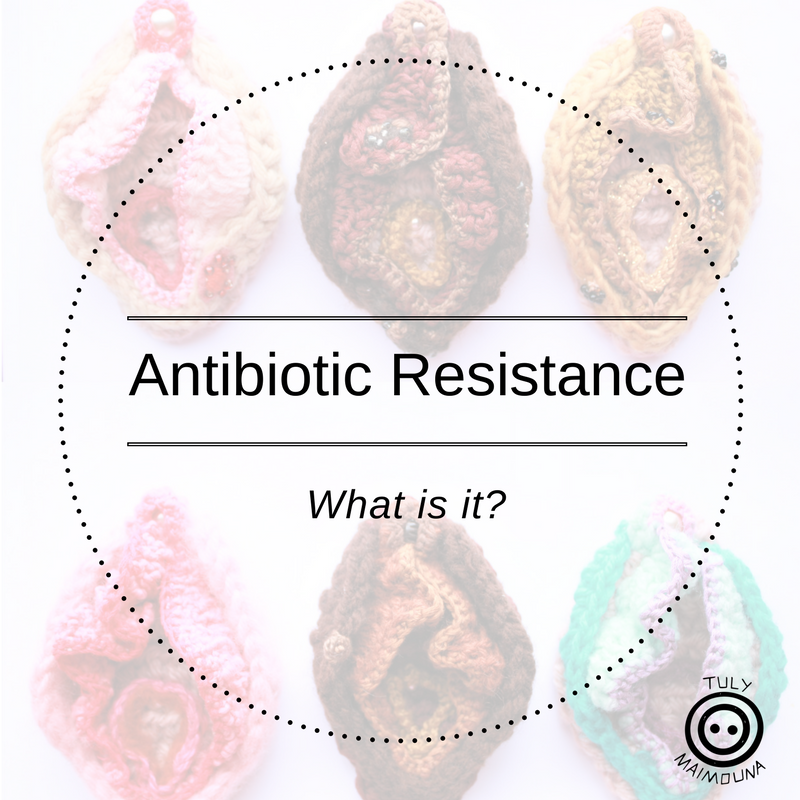
within a dotted circle black text reads, antibiotic resistance, what is it? The background image is a faded image of 6 crochet genitalia of different colours with varying representations of STI symptoms. vulva is

Antibiotic resistance is when bacteria are no longer responsive to antibiotics that are meant to kill them. When a bacteria is exposed to treatment too often (over-reliance on antibiotic treatment as illness management) or at infrequent low doses (when treatment is not fully completed/adhered to), like other living organisms its DNA changes to be able to survive.

Why does it matter?
Globally, there have been reports of gonorrhea (N. gonorrhoeae - bacteria name) strains that are resistant to first-line antibiotic therapy (like penicillin, tetracycline, erythromycin and ciprofloxacin - types of antibiotics). When bacterial infections, like gonorrhea, are no longer responsive to the medical treatments available it remains untreated in the body and can lead to health complications like: infertility, chronic pelvic pain, bacteria spreading to the blood causing nervous system damage, parent to child transmission, or ectopic pregnancies. Also, the presence on an STI in the body increases the likelihood getting another STI like chlamydia, or HIV (the virus that can lead to AIDS).

In Kanata (Canada), gonorrhea is the second most commonly diagnosed and reported bacterial STI. Much like the incidences of STIs, antibiotic resistance will vary from country to country, even regionally. The distribution of antibiotic resistance can be thought of in the same way as other STIs, the social determinants of health and health inequities are really important when thinking about why there are higher rates of certain antibiotic resistance both geographically and socially.

Sources Cited:
1. Centre of Disease Control and Prevention. 2017. Drug-Resistant Gonorrhea. Retrieved from: https://www.cdc.gov/drugresistance/solutions-initiative/drug-resistant-gonorrhea.html 

2. Public Health Agency of Canada. 2013. Canadian Guidelines on Sexually Transmitted Infections. Retrieved from: http://www.phac-aspc.gc.ca/std-mts/sti-its/cgsti-ldcits/section-5-6-eng.php#toc361210445
3. Public Health Agency of Canada. 2015. Canada Communicable Disease Report. Retrieved from: http://www.phac-aspc.gc.ca/std-mts/sti-its/cgsti-ldcits/section-5-6-eng.php#toc361210445
4. Tapsall J. Antibiotic resistance in Neisseria gonorrhoeae is diminishing available treatment options for gonorrhoea: Some possible remedies. Expert Rev Anti Infect Ther. 2006; 4:619-628

Tuesday, 21 February 2017

Vulva Is Syphilis Postive

one crochet genital with brown inner and outer lips and a brown clitoris is pictured on a white background. On the left outer lip is a light brown chancre that looks like a small bump, and it represents primary stage syphilis. Vulva Is.

Syphilis is a bacterial sexually transmitted infection (STI) that when present in the body can be passed on through skin-to-skin contact, birth, sharing used works (like crack pipes) for inhaling drugs, and sex without a barrier (condoms, gloves or dental dams). 


Symptoms:
Syphilis can progress through 3 stages if left untreated. In primary syphillis a small painless lesion (chancre) appears- then goes away, even if left untreated. In secondary syphilis- a rash develops on the body with flu like symptoms, and tertiary syphilis can lead to long term complications like brain damage or stroke.

Treatment:
Syphilis can be treated with antibiotics. It kills the bacteria in the body, but it does not reverse any damage it may have done.

Some options on prevention:
getting tested, completing treatment, using barriers when having sex, using new works and having convos with sexual partners about STIs

Historical (racist) fact:
Syphilis has come to symbolize racism in medicine through the Tuskegee Syphilis Study from 1932 - 1972. United States public health enlisted 399 poor black sharecroppers (a tenant farmer who gives a part of each crop as rent) living with syphilis in Macon country to track the effects of untreated syphilis. Without informed consent, the men were never told they had syphilis and were denied treatment even after the penicillin came into use in 1947. 28 men died from tertiary syphilis, 100 others died from complications, 40 wives were infected, and 19 children were born with syphilis.


For more information on Syphilis and other STIs, follow the jump below:
http://sexualhealthontario.ca/infections/syphilis/

Monday, 20 February 2017

The STI Series!

Centered between two lines text reads, sexually transmitted infections. The background image is a faded image of 6 crochet genitalia of different colours with varying representations of STI symptoms. Vulva Is.

I started doing sexual health education with other teens when I was 15 and in high school. When I got into doing workshops I found there weren't many visual resources available to talk about sexually transmitted infections (STI), other than the most exaggerated, fake or graphic images.


Having images that aren't fear mongering or body shaming are important tools of engagement to start/continue conversations about health. So after many days of researching, looking at images, and talking to people about genitals and STI's I've got this growing series of genitals with felted, beaded and embroidered representations of STI symptoms. This genital series aims to 
share information about the signs and symptoms of STIs (and lack thereof) so we can recognize them to be able to minimize STI transmission and/or the chances of getting one. So for the next little bit I'll be posting STI specific health things, starting with some biomedical info - which is one way to have conversations about health.


I'm so down for collabos on STI health and management, chats, questions & comments so get at me, yeah?